
PCB Panelization: V-cut Fees, Mouse Bites and Silkscreen Separation
Yes, PCB32 supports V-cut and mouse-bite panelization. Both methods follow the same pricing rules. However, a small panel does not automatically qualify for the special offer price. Your separation method and whether the panel contains different designs affect the quotation.
V-cut and mouse-bite pricing at PCB32
- V-cut and mouse-bite panels within 10 × 10 cm (100 × 100 mm) are not eligible for the special offer price. They are charged at the standard engineering fee plus board fee.
- If a V-cut or mouse-bite panel contains mixed designs, an additional $10 fee applies.
- Silkscreen-only separation is free of charge and is not considered mixed-design panelization. This means marking different design areas with silkscreen without requesting physical separation features.
For example, a 100 × 100 mm V-cut panel containing repeated copies of one design is charged at the standard engineering fee plus board fee. If that V-cut panel contains design A and design B, the additional $10 mixed-design fee applies.
Adding silkscreen labels to an existing mixed-design V-cut or mouse-bite panel does not remove its panelization or mixed-design charges. The free option is silkscreen-only separation. Other special-offer requirements still apply; free silkscreen separation does not guarantee that an order qualifies for a promotional price.
What is V-cut panelization?
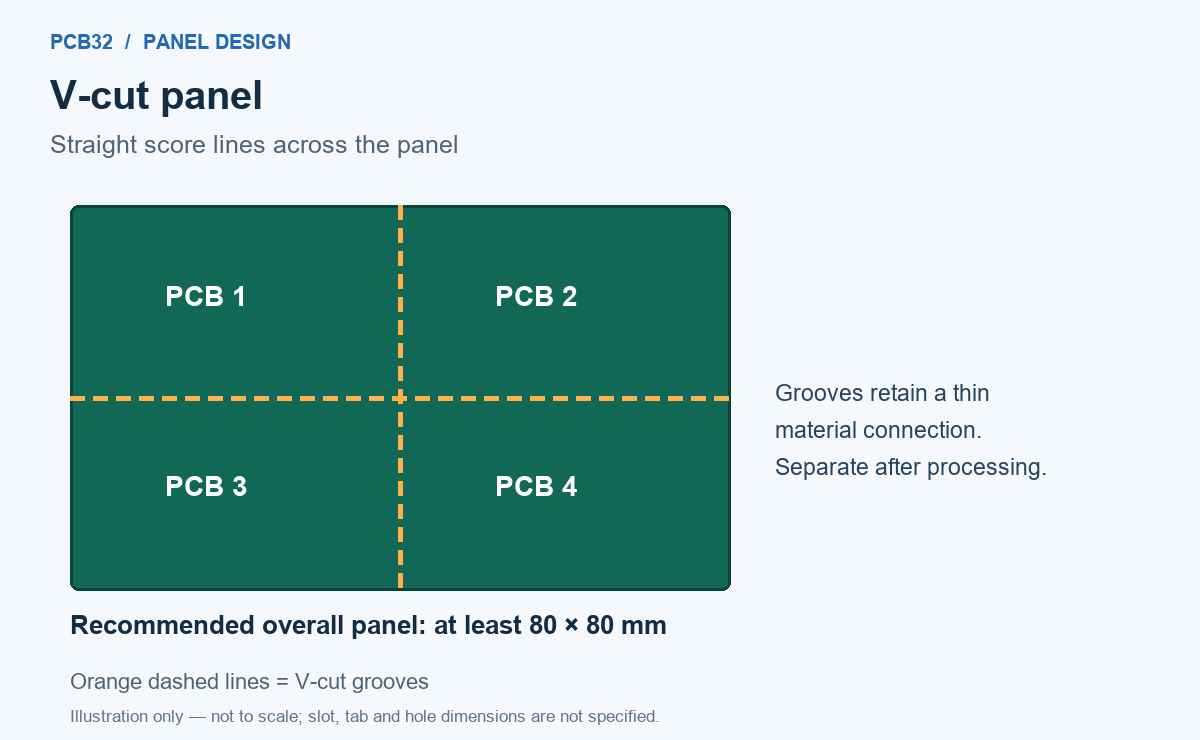
V-cut, also called V-scoring, uses grooves along the intended separation lines while leaving material that holds the boards together. The boards remain in a panel during handling or assembly and are separated later.
It is commonly used for rectangular boards arranged along straight lines. Conventional scoring runs across the panel, so do not assume that a V-cut line can stop midway or follow a curved outline. Irregular shapes may need routing or another panel arrangement. For layout preparation, see our PCB32 panel design guide.
PCB32 recommends a V-cut panel size of at least 80 × 80 mm (8 × 8 cm). This is the overall panel size, not each individual board. Both dimensions should meet the recommendation. Submit smaller panels for review. This recommendation does not change the special-offer exclusions described above.
V-cut design precautions
- Identify every score line clearly. Include a mechanical drawing or dedicated V-cut layer and state the requested process in your order notes. Do not rely on a silkscreen line alone as a machining instruction.
- Keep copper and components away from the separation area. Account for traces, pads, vias, component bodies and the clearance needed by the depaneling tool.
- Check panel rigidity. Board thickness, groove depth and remaining material affect stability during handling and assembly. Have these reviewed with your files.
- Plan depaneling before placing components. Bending a populated board can stress components and solder joints. Choose a suitable separation method and tool, especially near sensitive parts.
- Include assembly requirements. If assembly is needed, specify tooling rails, locating holes and fiducials as appropriate for the assembly process.
Do not copy another manufacturer’s minimum thickness, copper clearance or scoring dimensions into a PCB32 order without confirmation. Submit the proposed panel for engineering review.
What are mouse-bite panels?
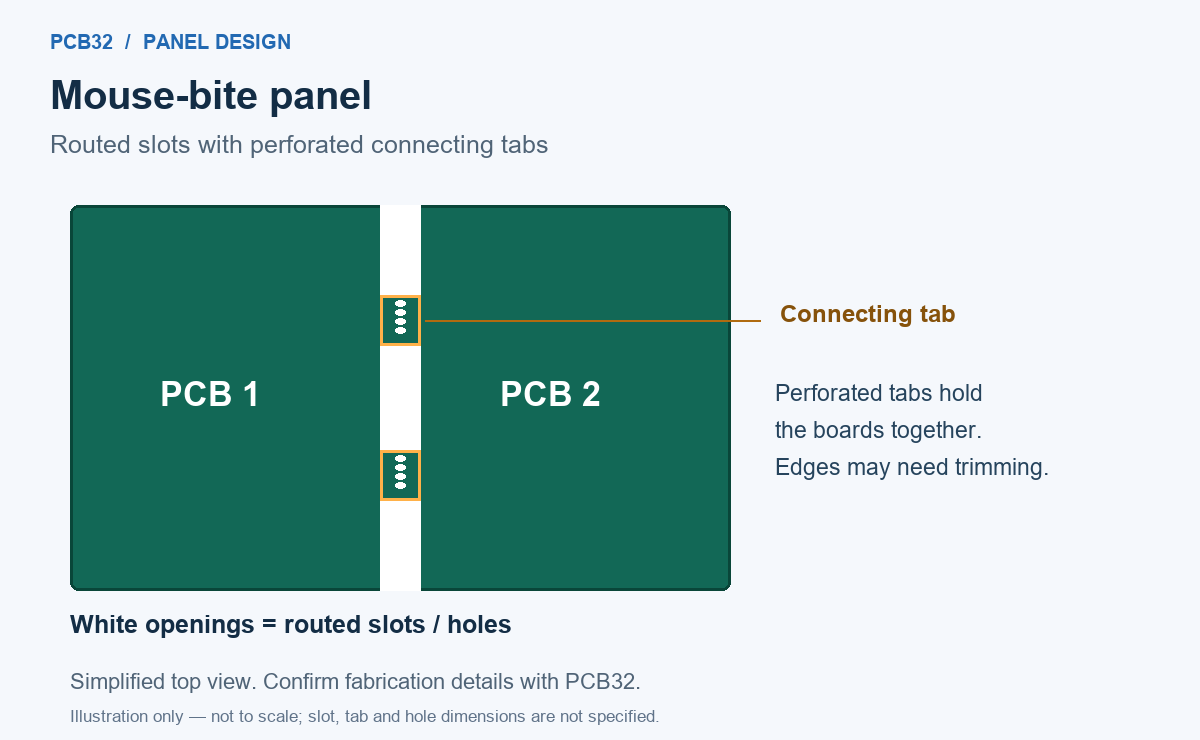
Mouse-bite panelization uses routed slots around the board outlines, leaving small connecting tabs with a row of holes. These perforated tabs hold the boards in the panel and provide locations for separation. This method is also called perforated-tab routing.
It offers more flexibility for irregular board outlines and tab placement than straight V-cut lines. Our panel design guide explains how to plan outlines, connecting tabs and assembly requirements.
Mouse-bite design precautions
- Balance strength and separation effort. Too few or poorly positioned tabs can leave the panel unstable; too many can make depaneling difficult.
- Allow room for the routing tool. Adjacent boards need space for the routed path. Confirm slot width, hole size, hole spacing and tab geometry with engineering.
- Plan for the finished edge. Broken tabs may leave small protrusions or rough edges that need trimming. Avoid placing tabs on edges that must fit tightly into an enclosure or guide.
- Keep sensitive features away from tabs. Consider copper clearance, nearby components and the stresses created during separation.
Mouse-bite panels follow the same pricing rules as V-cut panels. Panels within 100 × 100 mm are not eligible for the special offer price and are charged at the standard engineering fee plus board fee. If the panel contains mixed designs, an additional $10 applies. Silkscreen-only separation remains free; adding silkscreen to a mouse-bite panel does not waive these charges.
Other options: solid tabs and silkscreen separation
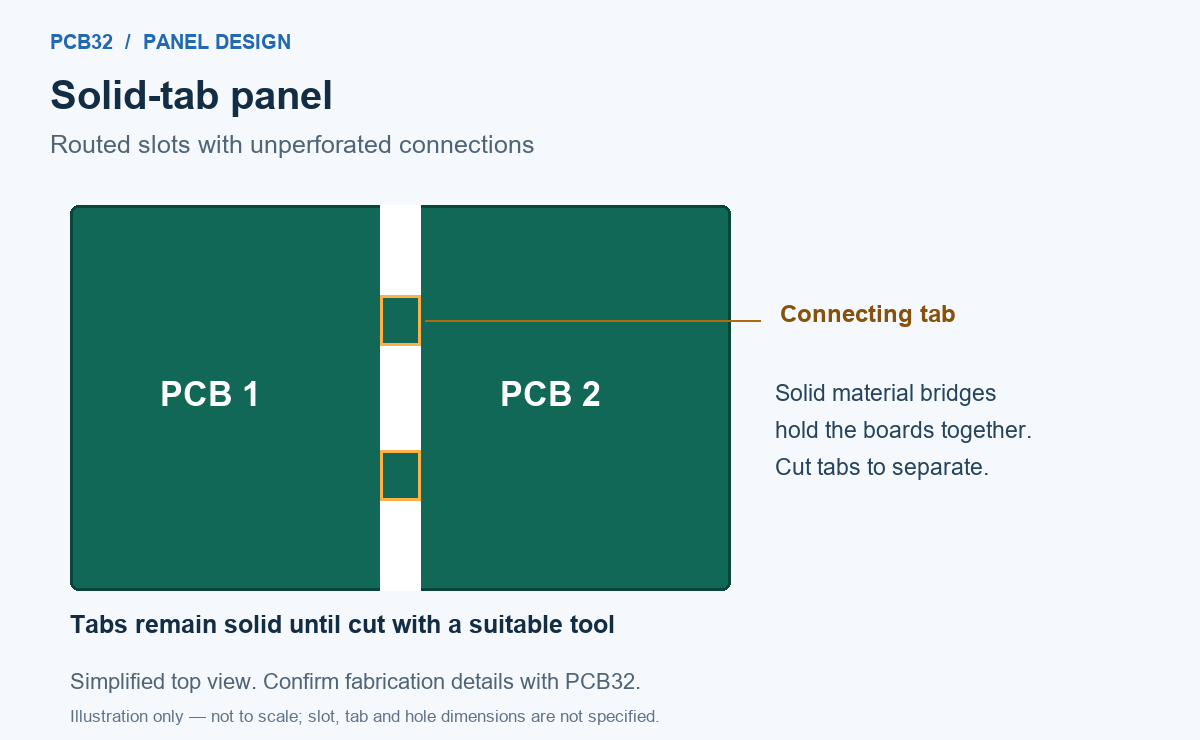
Routed panels with solid tabs retain unperforated connections between boards or between boards and a supporting frame. These tabs typically require a suitable cutting or routing tool to remove. Their placement, final edge quality, feasibility and pricing should be reviewed with the panel files.
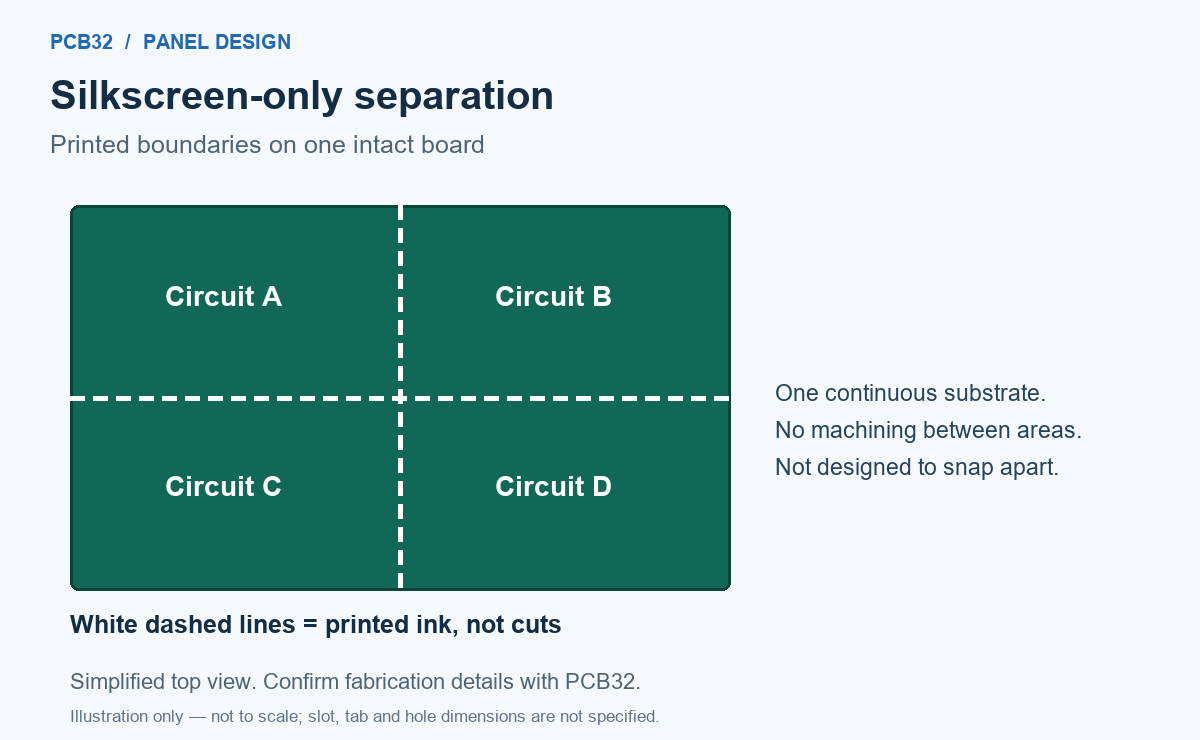
Silkscreen separation simply marks different circuit areas with printed lines or labels. It does not cut the substrate, interrupt copper or create an easy-to-break connection. It is useful when you want several circuit designs on one intact board for testing or prototyping.
For customers who do not need physically separated boards, PCB32 recommends considering silkscreen-only separation: the separation marking is free and is not treated as mixed-design panelization. If you need independent boards later, plan a suitable cutting process and clearances before ordering.
Which panel method should you choose?
- Straight rows of rectangular boards: consider V-cut after reviewing the standard engineering fee, board fee and any mixed-design surcharge.
- Irregular outlines or selective connection points: discuss mouse-bite or solid-tab routing with engineering and confirm the quotation.
- Multiple circuits that can remain on one board: consider free silkscreen-only separation.
- Tight enclosure fit or demanding edge quality: specify the final edge requirements before choosing tab locations or a separation method.
Before you submit your PCB order
Provide the Gerber and drill files, overall panel dimensions, individual board outlines, number of different designs, requested separation method and any assembly requirements. State whether you need delivery as intact panels or individual boards; confirm the available delivery arrangement in the quotation.
Ready to order? Open the PCB32 Standard PCB/PCBA quotation page, upload your fabrication files and include your panelization instructions. Our Gerber file checklist explains what to include, and the PCB32 quotation guide walks through the ordering process.